Skip to content
AD

Mercedes-Benz Nurburg Sedan (1928 - present)

Mercedes-Benz · 3 trims

Mercedes-Benz Nurburg Sedan

The Mercedes-Benz Nurburg Sedan (1928 - present) is available in 3 trims producing 80 to 100 hp. The fastest trim reaches 109 km/h. The lowest stated fuel consumption is 25.0 l/100 km.

Power
100 hp
0–100
Fuel economy
25.0 l/100 km
Cargo

Nurburg Sedan Trims

Compare →
Trims and engine versions — Mercedes-Benz Nurburg Sedan
Trim Fuel Power Torque 0–100 Top speed Fuel economy CO2 Select
460 Petrol 80 hp 238 Nm 100 km/h 25.0 l/100 km 595 g/km
460 II Petrol 80 hp 238 Nm 100 km/h 25.0 l/100 km 595 g/km
500 Petrol 100 hp 253 Nm 109 km/h 25.0 l/100 km 595 g/km

Fuel economy and CO2 follow the stated test cycle. Manufacturer figures; deviations per market and option pack are possible.

Is Mercedes-Benz Nurburg Sedan a good choice against other models?

Average across every Mercedes-Benz Nurburg Sedan trim, compared with 81 trims of other cars from the 1925–1931 period.

Is Mercedes-Benz Nurburg Sedan a good choice against other models?
Measure This model Average Position
Power 87 hp 121 hp
better than 36%
Top speed 103 km/h 135 km/h
better than 24%
Combined consumption 25.0 l/100 km 24.3 l/100 km
better than 53%

Percentages show the share of trims from the same period this model beats on that measure. Manufacturer figures.

Not stated by the manufacturer: acceleration 0–100 km/h and cargo volume. Those measures are left out of the comparison.

Comparable models from other brands

Renault SEAT Saab Samsung Subaru Chrysler

About Mercedes-Benz Nurburg Sedan

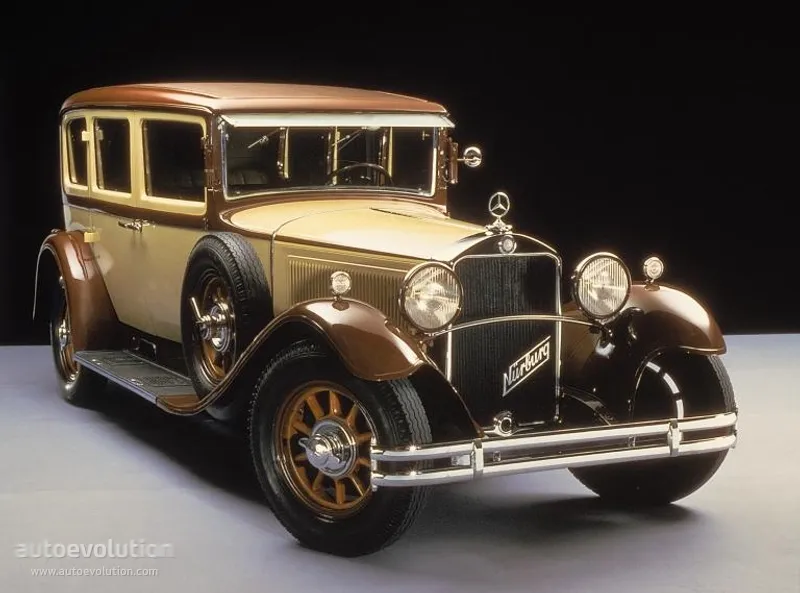
During his work for Mercedes-Benz, Ferdinand Porsche developed the Nurburg lineup, also known as the W08, which was available in a few body shapes but, most importantly, as a sedan.

The Nurburg lineup replaced the former W03, 04, and 05 models, and the car's name came from the grueling testing program created by the German automaker. That test was performed for 13 days on the Nurburgring racetrack and the vehicle covered 20,000 km (12,427 miles). As expected, the sedan version was the most sought-after version, and it was also the most luxurious one.

Since the Nurburg Sedan was powered by an inline-eight, it forced the automaker to create a longer engine compartment. But that didn't spoil the car's look, on au contrary. At the front, Mercedes-Benz installed a curved chromed bar between the thin fenders, where it mounted the headlights. That design solution became a signature for the three-pointed-star brand from Stuttgart. From its profile, the high-chassis system and the four-door bodywork offered a luxurious image for customers. Still, in those times, automakers didn't install a specific luggage compartment, so after the cabin, the vehicle ended abruptly. Yet, a rack was added behind for suitcases or chests.

Featuring the longest wheelbase in its family, the Sedan provided enough room for up to five occupants. Depending on the version, the rear seats could've been completely separated by the driver and the side occupant, which was most of the time a guard. Mercedes-Benz installed a four-spoke steering wheel, which also sported the controls for ignition timing and air/fuel ratio.

Mercedes-Benz installed the same engine with different power outputs for the entire Nurburg range. The 4.6-liter supercharged version provided 80 hp, while the full-option model featured a 5.0-liter 100 hp unit.

How much power does the Mercedes-Benz Nurburg Sedan have?

The most powerful Mercedes-Benz Nurburg Sedan trim is the 500 with 100 hp. The model has 3 trims, starting at 80 hp.

What is the fuel consumption of the Mercedes-Benz Nurburg Sedan?

The most economical Mercedes-Benz Nurburg Sedan trim is the 460, with a stated combined consumption of 25.0 l/100 km and 595 g CO2 per km.

Other Mercedes-Benz models