Skip to content
AD

Mercedes-Benz Typ SS (W06) (1928 - 1933)

Mercedes-Benz · 2 trims

Mercedes-Benz Typ SS (W06)

The Mercedes-Benz Typ SS (W06) (1928 - 1933) is available in 2 trims producing 200 to 225 hp. The fastest trim reaches 190 km/h. The lowest stated fuel consumption is 27.0 l/100 km.

Power
225 hp
0–100
Fuel economy
27.0 l/100 km
Cargo

Typ SS (W06) Trims

Compare →
Trims and engine versions — Mercedes-Benz Typ SS (W06)
Trim Fuel Power Torque 0–100 Top speed Fuel economy CO2 Select
7.1 Kompressor (27/160/200) Petrol 200 hp 450 Nm 185 km/h 27.0 l/100 km 643 g/km
7.1 Kompressor (27/170/225) Petrol 225 hp 453 Nm 190 km/h 27.0 l/100 km 643 g/km

Fuel economy and CO2 follow the stated test cycle. Manufacturer figures; deviations per market and option pack are possible.

Is Mercedes-Benz Typ SS (W06) a good choice against other models?

Average across every Mercedes-Benz Typ SS (W06) trim, compared with 82 trims of other cars from the 1925–1931 period.

Is Mercedes-Benz Typ SS (W06) a good choice against other models?
Measure This model Average Position
Power 213 hp 118 hp
better than 94%
Top speed 188 km/h 132 km/h
better than 94%
Combined consumption 27.0 l/100 km 24.3 l/100 km
better than 35%

Percentages show the share of trims from the same period this model beats on that measure. Manufacturer figures.

Not stated by the manufacturer: acceleration 0–100 km/h, cargo volume and unladen weight. Those measures are left out of the comparison.

Comparable models from other brands

DS Automobiles Peugeot Saab Holden Mazda Cupra

About Mercedes-Benz Typ SS (W06)

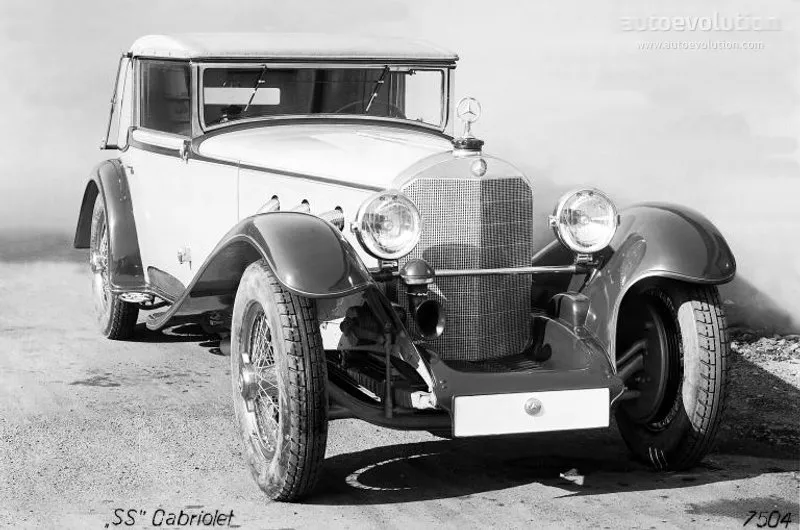
Mercedes-Benz introduced the W06 range in 1927, starting with the model S, which was built as a sports car and for sporting events, followed by the SS in 1928.

The German carmaker knew that its name would be on everybody's lips if it was going to win races, so it focused on developing a sports car. Thus, the S version won the German Grand Prix in 1927, and those interested in faster vehicles asked for more. And thus, the carmaker introduced the SS model in the following year. It was the Super Sports car of the moment, a symbol of luxury and speed, and a grand tourer.

Like many other models from Mercedes' lineup, the SS was available in a few shapes or as a bare chassis. But all of them shared the same V-shaped radiator grille. The front wheels were pushed forward in front of the radiator and engine compartment, and the chromed bar that supported the headlights was mounted between the arched front fenders. In addition, the carmaker added a bumper mounted on the chassis' endings to protect the vehicle in case of an accident. The rounded shape of the hood was carried over for a few decades afterward. Finally, to protect the car's occupants, Mercedes-Benz added a short, flat windshield fitted with a pair of wipers on the upper side.

But the carmaker knew its clients enjoyed luxurious vehicles, so it fitted the cabin with expensive materials. Two or four seats were inside depending on what kind of bodywork they chose. Another version featured tumbling seats behind the cabin and the rear axle.

Under the hood stood a big, 7.1-liter engine that produced 200 hp in the low-power version, with an option for a 225 hp. But for those who had deeper pockets and a need for speed, there was a special set of camshafts that could help the engine produce up to 275 hp. The carmaker produced 111 units of this SS model between 1928 and 1933, but the car stayed on the price lists until 1935.

How much power does the Mercedes-Benz Typ SS (W06) have?

The most powerful Mercedes-Benz Typ SS (W06) trim is the 7.1 Kompressor (27/170/225) with 225 hp. The model has 2 trims, starting at 200 hp.

What is the fuel consumption of the Mercedes-Benz Typ SS (W06)?

The most economical Mercedes-Benz Typ SS (W06) trim is the 7.1 Kompressor (27/160/200), with a stated combined consumption of 27.0 l/100 km and 643 g CO2 per km.

Other Mercedes-Benz models