
Skip to content
AD

Saab 9000 CS (1991 - 1998)

Saab · 13 trims

Saab 9000 CS

The Saab 9000 CS (1991 - 1998) is available in 13 trims producing 131 to 224 hp. The fastest trim reaches 240 km/h. The lowest stated fuel consumption is 9.0 l/100 km.

Power
224 hp
0–100
6.9 s
Fuel economy
9.0 l/100 km
Cargo
487 l

9000 CS Trims

Compare →
Trims and engine versions — Saab 9000 CS
Trim Fuel Power Torque 0–100 Top speed Fuel economy CO2 Select
2.0i 5MT (130 HP) Petrol 131 hp 177 Nm 11.5 s 200 km/h 10.5 l/100 km 250 g/km
2.3i 4AT (147 HP) Petrol 147 hp 205 Nm 10.0 s 210 km/h 9.2 l/100 km 217 g/km
2.3i 5MT (147 HP) Petrol 147 hp 205 Nm 10.0 s 210 km/h 9.2 l/100 km 217 g/km
2.0L Turbo 4AT (150 HP) Petrol 150 hp 215 Nm 11.5 s 210 km/h 11.2 l/100 km 236 g/km
2.0L Turbo 5MT (150 HP) Petrol 150 hp 215 Nm 9.5 s 210 km/h 9.9 l/100 km 236 g/km
2.3i 4AT (150 HP) Petrol 150 hp 212 Nm 10.5 s 205 km/h 9.1 l/100 km 217 g/km
2.3i 5MT (150 HP) Petrol 150 hp 212 Nm 10.5 s 205 km/h 9.1 l/100 km 217 g/km
2.3L T 4AT (170 HP) Petrol 170 hp 260 Nm 9.5 s 220 km/h 11.3 l/100 km 238 g/km
2.3L T 5MT (170 HP) Petrol 170 hp 260 Nm 8.5 s 220 km/h 9.6 l/100 km 238 g/km
2.3L Turbo 4AT (200 HP) Petrol 200 hp 329 Nm 7.5 s 230 km/h 9.0 l/100 km 238 g/km
2.3L Turbo 5MT (200 HP) Petrol 200 hp 329 Nm 7.5 s 230 km/h 9.0 l/100 km 238 g/km
3.0i V6 5MT (211 HP) Petrol 211 hp 270 Nm 8.0 s 230 km/h 9.3 l/100 km 221 g/km
2.3L Turbo Aero 5MT (224 HP) Petrol 224 hp 342 Nm 6.9 s 240 km/h 10.0 l/100 km 238 g/km

Fuel economy and CO2 follow the stated test cycle. Manufacturer figures; deviations per market and option pack are possible.

Is Saab 9000 CS a good choice against other models?

Average across every Saab 9000 CS trim, compared with 2,161 trims of other cars from the 1988–1994 period.

Is Saab 9000 CS a good choice against other models?
Measure This model Average Position
Power 169 hp 135 hp
better than 77%
Torque 249 Nm 202 Nm
better than 76%
Top speed 217 km/h 192 km/h
better than 80%
Acceleration 0–100 km/h 9.3 s 11.7 s
better than 75%
Combined consumption 9.7 l/100 km 8.8 l/100 km
better than 28%
CO2 emissions 231 g/km 210 g/km
better than 26%
Cargo volume 487 l 444 l
better than 73%
Unladen weight 1,390 kg 1,277 kg
better than 32%

Percentages show the share of trims from the same period this model beats on that measure. Manufacturer figures.

Comparable models from other brands

Peugeot Holden DS Automobiles Mercedes-Benz Mazda Toyota

About Saab 9000 CS

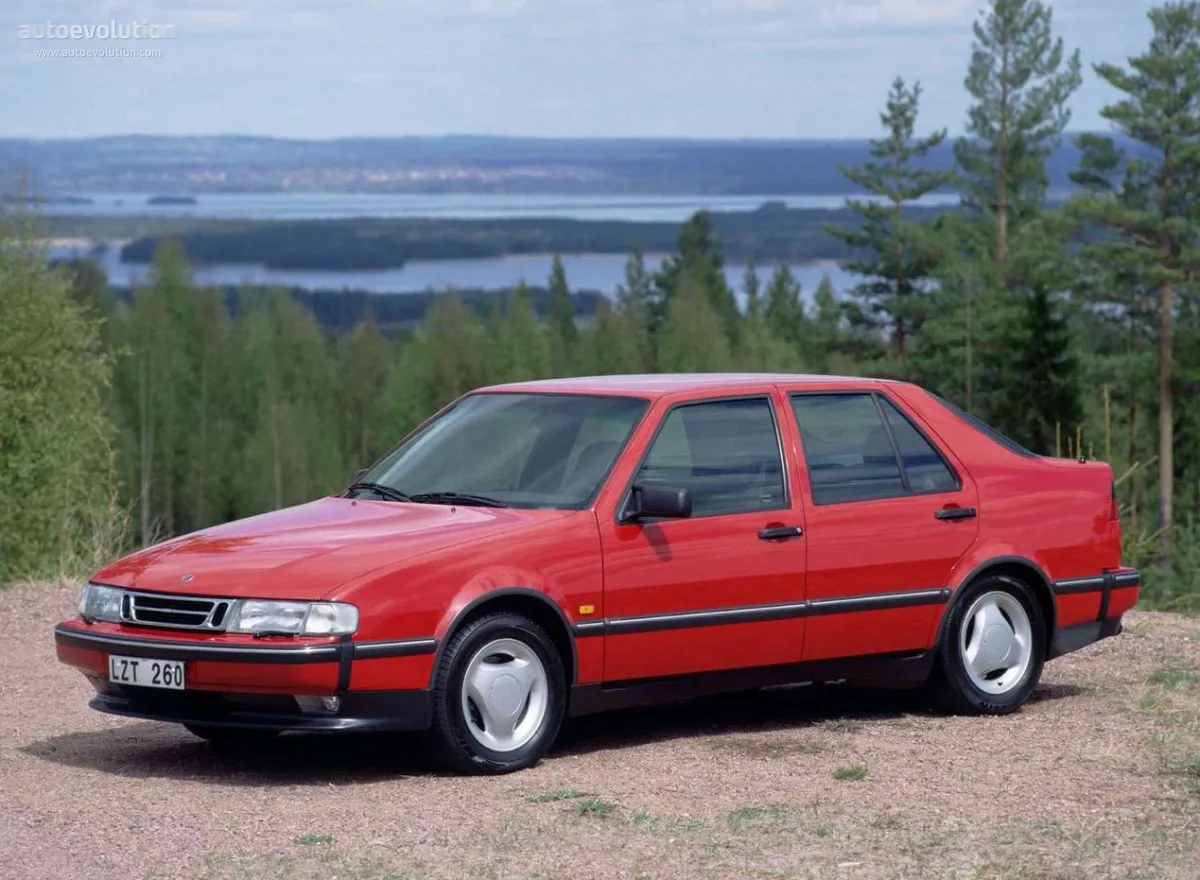
If someone would put in a blender an Italian platform, a GM engine, and a Giorgetto Giugiaro design, the result would be Swedish. And that was the Saab 9000 CS.

The 9000 was introduced in 1984 but it was upgraded in 1991. The upgrade was so intensive that it could have been named a new generation. But it was the exterior design that showed the connection with the 1984 model.

The Saab 9000 shared some of its body panels with the Fiat Croma and Lancia Thema. The doors were identical. Only the door handles were different. But that's where the shared components ended. The Sweedish car featured a sleek front with horizontal headlights that matched the company design language. In the back, the U.S. version didn't feature lights on the liftgate, since the regulations didn't allow a brake light on them. On the European models, the two taillights were connected via a red light strip across the back panel.

Inside, the Saab 9000 featured a specific dashboard with a big center console tilted toward the driver. The night-panel function shut off all the lights on the instrument cluster and left only the speedometer lit. As usual, the ignition key was placed between the front seats, next to the handbrake, and the gear-stick. In the back, there was enough room for three adult passengers.

The Saab was known for its turbo-powered engines and, in 1992, it introduced the 2.3-liter turbocharged unit that offered sports-cars performance in a family-oriented vehicle.

How much power does the Saab 9000 CS have?

The most powerful Saab 9000 CS trim is the 2.3L Turbo Aero 5MT (224 HP) with 224 hp. The model has 13 trims, starting at 131 hp.

What is the fuel consumption of the Saab 9000 CS?

The most economical Saab 9000 CS trim is the 2.3L Turbo 4AT (200 HP), with a stated combined consumption of 9.0 l/100 km and 238 g CO2 per km.

How quickly does the Saab 9000 CS accelerate from 0 to 100 km/h?

The quickest trim is the 2.3L Turbo Aero 5MT (224 HP): 0-100 km/h in 6.9 seconds, with a top speed of 240 km/h.

How large is the cargo volume of the Saab 9000 CS?

The largest stated cargo volume for the Saab 9000 CS is 487 litres.

Other Saab models

Saab 9000 CD

1994 - 1997 · 11 trims

Power
211 hp
0–100
7.5 s
Fuel economy
9.2

Petrol

Saab 90

1984 - 1987 · 1 trim

Power
100 hp
0–100
14.0 s
Fuel economy
10.0

Petrol

Saab 9-2X

2004 - 2006 · 2 trims

Power
230 hp
0–100
Fuel economy
9.4

Petrol

Saab Turbo X

2008 - 2012 · 2 trims

Power
280 hp
0–100
6.2 s
Fuel economy
10.9

Petrol

Saab 9-3X

2009 - 2012 · 3 trims

Power
209 hp
0–100
8.5 s
Fuel economy
5.5

Petrol Diesel CNG