About Holden Frontera
In 1999, Holden introduced the second generation of the Frontera for the Australian and New Zealand markets, trying to expand its presence in the growing SUV segment.
Isuzu wasn’t known as a specialist in the SUV segment, but it was reckoned as a car manufacturer with trustworthy products thanks to the trucks and utility vehicles it produced. As a result, in 1989, it launched the MU lineup for the Japanese market, and GM quickly adopted and sold the new car in other countries under different brands and nameplates. As a result, Europeans knew it as the Opel/Vauxhall Frontera, but in the U.S., it was available as the Isuzu Rodeo/Honda Passport. At the same time, Australians met the new vehicle with the Holden Frontera nameplate. The first generation was introduced in 1995, while its successor appeared on the Australasian market in 1999.
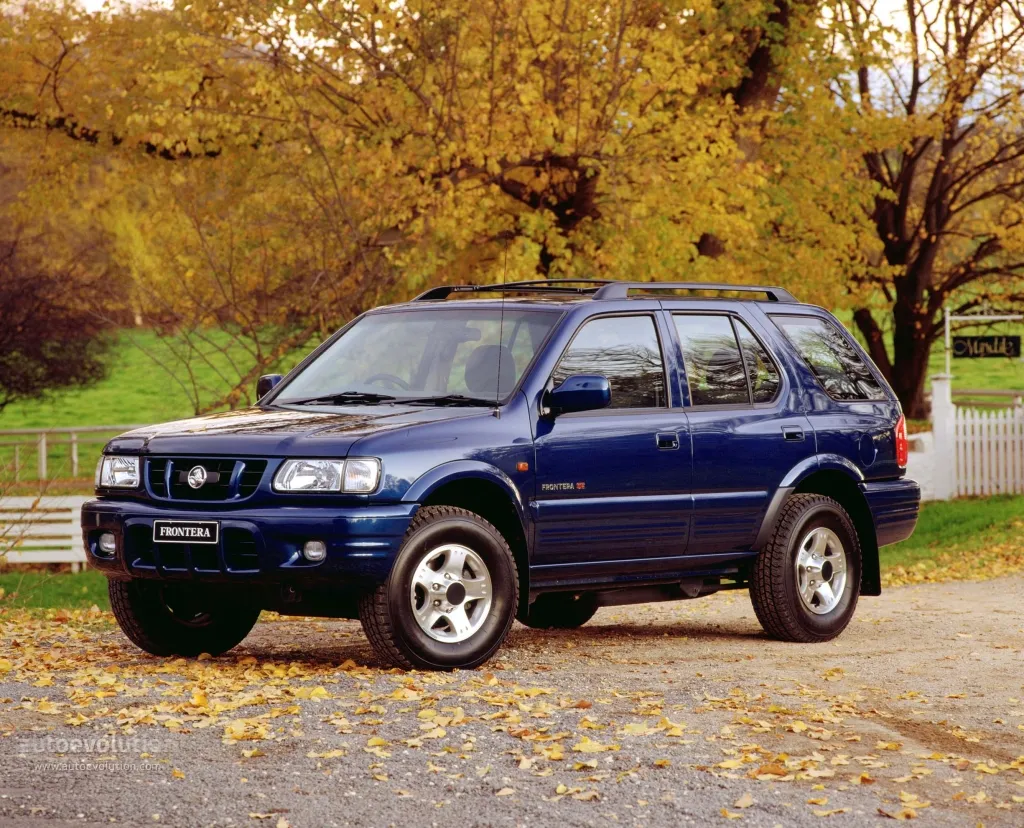
Along with the introduction of the second generation of the Frontera, the vehicle’s design got smoother. Its front fascia featured horizontal headlights with rounded edges and corner-mounted turn signal lamps that resembled those from the Nissan Patrol. Between them, Holden installed a black mesh grille where the brand’s badge took center stage and was adorned with body-colored trim. Lower, the 1999 Holden Frontera had a wrapped-around plastic bumper with available round fog lamps on both ends.
Like its predecessor, the 1999 Holden Frontera was available as a convertible, as a three-door hard-top, or as a five-door vehicle. While the former two had a short wheelbase, the latter targeted families with children and had a more extended distance between the front and rear axles. However, regardless of the bodywork version, the automaker installed flared front fenders with smooth lines. In addition, the body-colored door mirrors and handles improved the vehicle’s look. The raked-forward C-pillars behind the rear doors created a dynamic look for Holden’s medium-sized SUV. Between them and the back of the Frontera, the automaker installed a third row of windows with a rhomboidal shape. Finally, at the back, the raked-forward tailgate had an independent opening for the rear window to ease the loading and unloading of light shopping bags directly into the trunk.
Inside, the 1999 Holden Frontera boasted an elegant cabin with a rounded-shaped dashboard featuring a center console that housed the HVAC system and an available CD stereo. The four-spoke steering wheel framed an easy-to-read instrument panel with large dials for the speedometer and tachometer. They were flanked by the coolant temperature gauge on the left and by the fuel level indicator on the right. At the front, the bucket seats had some bolstered areas, thus providing some side support for their customers. At the back, the split-folding bench seat could increase the generous size of the trunk. It is worth noting that the automaker kept the spare wheel on a cradle behind the tailgate, not inside the luggage area, even though there was plenty of room thanks to the car’s long wheelbase.
Under the hood, the automaker installed a choice of diesel and gasoline engines with four or six cylinders. They were paired as standard to a five-speed manual gearbox. Customers could get the 1999 Holden Frontera in 2WD or 4WD configuration. In addition, the oil burner and the V6 versions were available with four-speed automatic transmissions. Thanks to its front independent suspension, the SUV was more comfortable than other vehicles in its category that featured rigid axles on both ends.