Skip to content
AD

Mercedes-Benz Typ 320 Cabriolet D (W142) (1937 - 1942)

Mercedes-Benz · 2 trims

Mercedes-Benz Typ 320 Cabriolet D (W142)

The Mercedes-Benz Typ 320 Cabriolet D (W142) (1937 - 1942) is available in 2 trims producing 78 to 78 hp. The fastest trim reaches 126 km/h. The lowest stated fuel consumption is 17.2 l/100 km.

Power
78 hp
0–100
Fuel economy
17.2 l/100 km
Cargo

Typ 320 Cabriolet D (W142) Trims

Compare →
Trims and engine versions — Mercedes-Benz Typ 320 Cabriolet D (W142)
Trim Fuel Power Torque 0–100 Top speed Fuel economy CO2 Select
320 Petrol 78 hp 218 Nm 126 km/h 17.2 l/100 km 408 g/km
320 (3.4 L) Petrol 78 hp 218 Nm 126 km/h 17.2 l/100 km 408 g/km

Fuel economy and CO2 follow the stated test cycle. Manufacturer figures; deviations per market and option pack are possible.

Is Mercedes-Benz Typ 320 Cabriolet D (W142) a good choice against other models?

Average across every Mercedes-Benz Typ 320 Cabriolet D (W142) trim, compared with 92 trims of other cars from the 1934–1940 period.

Is Mercedes-Benz Typ 320 Cabriolet D (W142) a good choice against other models?
Measure This model Average Position
Power 78 hp 98 hp
better than 46%
Top speed 126 km/h 125 km/h
better than 50%
Combined consumption 17.2 l/100 km 16.2 l/100 km
better than 32%
CO2 emissions 408 g/km 416 g/km
better than 39%

Percentages show the share of trims from the same period this model beats on that measure. Manufacturer figures.

Not stated by the manufacturer: acceleration 0–100 km/h, cargo volume and unladen weight. Those measures are left out of the comparison.

Comparable models from other brands

Mitsubishi BMW Fiat Renault Proton

About Mercedes-Benz Typ 320 Cabriolet D (W142)

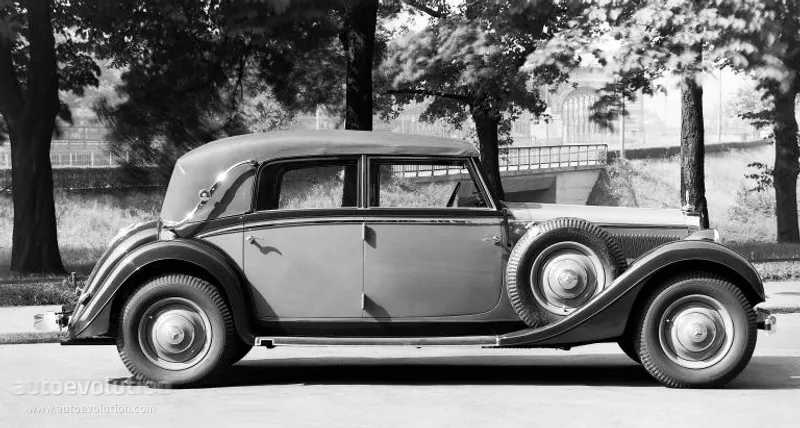
After the world economic crisis from the beginning of the '30s, Mercedes-Benz started to expand again and introduced the Typ 320 lineup in a few shapes and sizes.

The carmaker made the new lineup with a choice of two wheelbases, as a closed or an open-type bodywork. That helped the German carmaker to offer the vehicle as a sedan, coupe, and convertible with two or four doors, such as the Cabriolet D, which was built on the longer version of the chassis, carried over from the Typ 290.

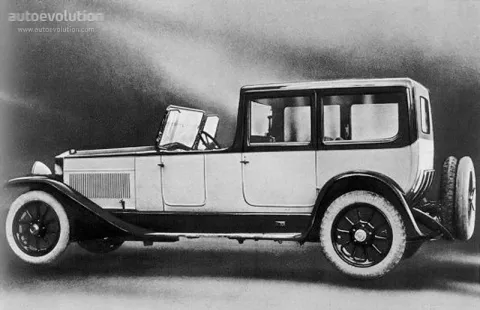
Imagined as a luxurious and fast vehicle, the Cabriolet D featured the new V-shaped radiator at the front flanked by the headlights. These were no longer mounted on a cross-bar in front of the radiator but between the fenders and the tall engine compartment. Its curved, exposed fenders were shorter to accommodate the spare wheels mounted on the sides and continued by the car's side steps. The open-top Cabriolet D featured cranked side windows for everyone. At the back, the carmaker installed a lockable trunk with shelves for luggage.

Thanks to the four-door bodywork, the ingress and egress were easy. Moreover, the driver's seat could have been tilted forward to help access both seats on the rear bench. Like its siblings, the Cabriolet D featured a four-spoke steering wheel, and the instrument panel was located in the middle of the dashboard.

Under the hood, Mercedes-Benz installed a 3.2-liter engine that was later on replaced by a 3.4-liter unit. Both versions were mated to a four-speed manual gearbox.

How much power does the Mercedes-Benz Typ 320 Cabriolet D (W142) have?

The most powerful Mercedes-Benz Typ 320 Cabriolet D (W142) trim is the 320 with 78 hp. The model has 2 trims, starting at 78 hp.

What is the fuel consumption of the Mercedes-Benz Typ 320 Cabriolet D (W142)?

The most economical Mercedes-Benz Typ 320 Cabriolet D (W142) trim is the 320, with a stated combined consumption of 17.2 l/100 km and 408 g CO2 per km.

Other Mercedes-Benz models