Skip to content
AD

Volvo 144 (1967 - present)

Volvo · 4 trims

Volvo 144

The Volvo 144 (1967 - present) is available in 4 trims producing 86 to 126 hp. The fastest trim reaches 171 km/h.

Power
126 hp
0–100
14.1 s
Fuel economy
Cargo
609 l

144 Trims

Compare →
Trims and engine versions — Volvo 144
Trim Fuel Power Torque 0–100 Top speed Fuel economy CO2 Select
1.8L 4MT RWD (86 HP) Petrol 86 hp 152 Nm
2.0L 4MT RWD (101 HP) Petrol 101 hp 152 Nm
1.8L 4MT RWD (105 HP) Petrol 105 hp 146 Nm 14.1 s 148 km/h
2.0L 4MT RWD (126 HP) Petrol 126 hp 167 Nm 171 km/h

Fuel economy and CO2 follow the stated test cycle. Manufacturer figures; deviations per market and option pack are possible.

Is Volvo 144 a good choice against other models?

Average across every Volvo 144 trim, compared with 385 trims of other cars from the 1964–1970 period.

Is Volvo 144 a good choice against other models?
Measure This model Average Position
Power 105 hp 173 hp
better than 32%
Torque 154 Nm 278 Nm
better than 30%
Top speed 160 km/h 179 km/h
better than 31%
Acceleration 0–100 km/h 14.1 s 12.3 s
better than 25%
Cargo volume 609 l 334 l
better than 94%
Unladen weight 1,240 kg 1,320 kg
better than 55%

Percentages show the share of trims from the same period this model beats on that measure. Manufacturer figures.

Not stated by the manufacturer: combined consumption and co2 emissions. Those measures are left out of the comparison.

Comparable models from other brands

Nissan Renault Ferrari Holden Lancia Mercedes-Benz

About Volvo 144

Volvo ended the Amazon series and introduced the 140 lineup in 1966, along with a new naming system that followed until the late '80s and the 144 was one of them.

The new naming system showed the first number as the series, the second represented the number of cylinders, and the last was for the number of doors. This means the 144 was the first series of the new wave with a four-cylinder engine and four doors. Its siblings were the 142 (the coupe) and the 145 (the station wagon). This car was significant in Volvo's heritage since it defined a design concept that continued until 1998, when it died along with the 960 model.

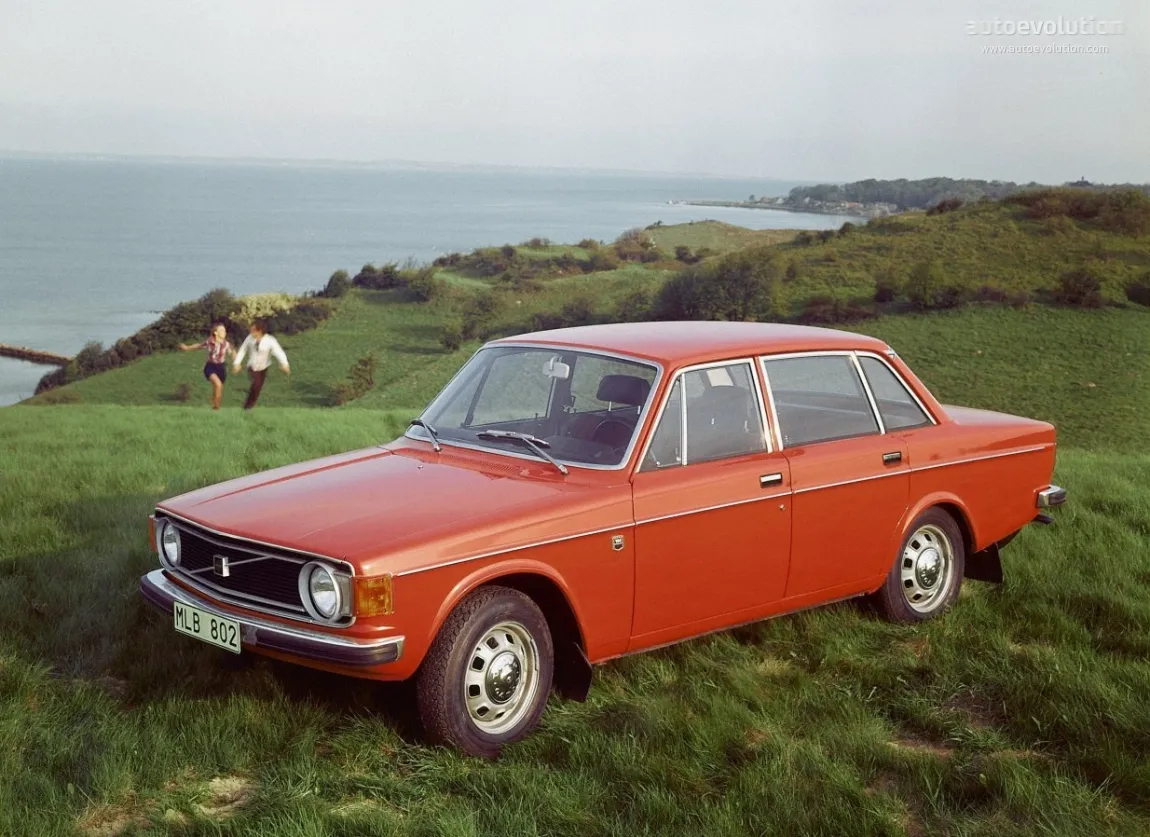
In 1967, when many other automakers tried to shape their cars with rounded edges, Volvo did the opposite. It made the 144 with flat surfaces, just slightly shaved corners, and an overall rugged look. The only round parts on the bodywork were the headlights. Between them was a flat grille with horizontal slats divided in two. From its sides, the wedged shapes continued on the greenhouse and at the back. Even the taillights were squared and divided into rectangular parts for braking and reversing lights, turn signals, and parking lights.

Inside, the carmaker kept the same wedged shapes of the exterior. It even offered a center stack that hosted the ventilation controls for the upper trim levels. The flat bucket seats at the front inspired the one behind the wheel to drive slower since they offered no side support. But at least the car came fitted with safety belts, which was a huge safety improvement.

Under the hood, Volvo installed the same 1.8-liter powerplant from the rest of the 140 range, and it was mated either with a four-speed manual, a four-speed manual with electrical overdrive, or a three-speed automatic.

How much power does the Volvo 144 have?

The most powerful Volvo 144 trim is the 2.0L 4MT RWD (126 HP) with 126 hp. The model has 4 trims, starting at 86 hp.

How quickly does the Volvo 144 accelerate from 0 to 100 km/h?

The quickest trim is the 1.8L 4MT RWD (105 HP): 0-100 km/h in 14.1 seconds, with a top speed of 148 km/h.

How large is the cargo volume of the Volvo 144?

The largest stated cargo volume for the Volvo 144 is 609 litres.

Other Volvo models

Volvo 142

1967 - 1974 · 3 trims

Power
135 hp
0–100
Fuel economy

Petrol

Volvo 145

1967 - 1974 · 4 trims

Power
126 hp
0–100
10.1 s
Fuel economy

Petrol

Volvo P1800

1961 - 1973 · 1 trim

Power
97 hp
0–100
Fuel economy

Petrol

Volvo 244

1975 - 1990 · 8 trims

Power
155 hp
0–100
9.0 s
Fuel economy
8.3

Petrol Diesel

Volvo 245

1975 - 1990 · 8 trims

Power
155 hp
0–100
9.0 s
Fuel economy
8.7

Petrol Diesel

Volvo 66

1975 - 1981 · 2 trims

Power
57 hp
0–100
18.5 s
Fuel economy

Petrol