Skip to content
AD

BMW 326 (1936 - 1941)

BMW · 1 trim

BMW 326

The BMW 326 (1936 - 1941) is available in 1 trims producing 51 to 51 hp. The fastest trim reaches 116 km/h. The lowest stated fuel consumption is 12.5 l/100 km.

Power
51 hp
0–100
35.0 s
Fuel economy
12.5 l/100 km
Cargo

326 Trims

Compare →
Trims and engine versions — BMW 326
Trim Fuel Power Torque 0–100 Top speed Fuel economy CO2 Select
2.0L 4MT (51 HP) Petrol 51 hp 35.0 s 116 km/h 12.5 l/100 km

Fuel economy and CO2 follow the stated test cycle. Manufacturer figures; deviations per market and option pack are possible.

Is BMW 326 a good choice against other models?

Average across every BMW 326 trim, compared with 107 trims of other cars from the 1933–1939 period.

Is BMW 326 a good choice against other models?
Measure This model Average Position
Power 51 hp 95 hp
better than 27%
Top speed 116 km/h 123 km/h
better than 48%
Combined consumption 12.5 l/100 km 17.5 l/100 km
better than 76%
Unladen weight 1,125 kg 1,696 kg
better than 78%

Percentages show the share of trims from the same period this model beats on that measure. Manufacturer figures.

Not stated by the manufacturer: torque, co2 emissions and cargo volume. Those measures are left out of the comparison.

Comparable models from other brands

Hindustan Fiat Citroën Honda

About BMW 326

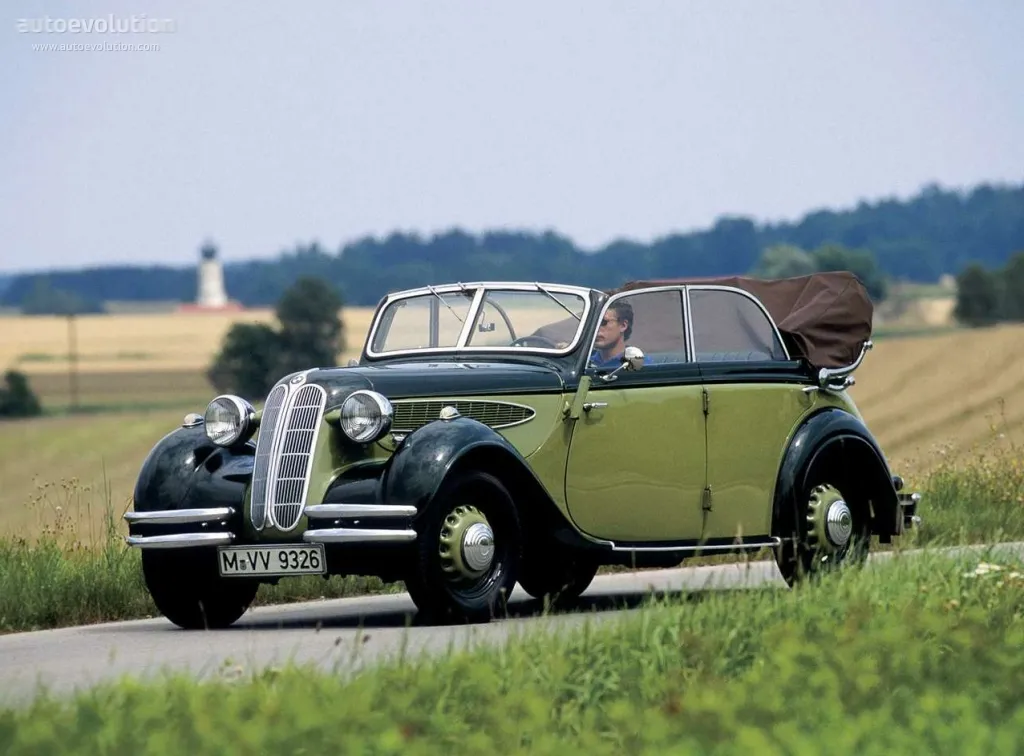
The BMW 326 Convertible was, basically, the open-top version of a respected two-door sedan, but it was pitted against its brother BMW 327 that was a faster, shorter and lighter vehicle. That's why is it so rare.

In 1936, the BMW dared to build its first four-door sedan and it was also offered as a convertible even though in those times the German car-manufacturer had already plans for new open-top vehicles. The convertible version was based on the same chassis as the sedan, which should have to decrease the production costs. But it wasn't a cheap vehicle and, but due to its quality and comfort, was sold well.

The outside featured flared, big front fenders and, between them, there was a different body for the engine compartment. The big, long hood was opened wither to the rear or via two side panels, An interesting feature was noticed at the windshield. It was split in two and the wipers were mounted on top. Due to this system, the windshield was opened from the bottom and tilted outside.

The chassis had some inspiration from the Citroen Traction Avant, with a torsion bar suspension at the rear and hydraulic braking system, the first to be used on a BMW car. The inline-six engine was of unusual construction, with the aluminum engine block and cast-iron cylinder head. The twin carburetor was an upside-down system and each was feeding three cylinders.

How much power does the BMW 326 have?

The most powerful BMW 326 trim is the 2.0L 4MT (51 HP) with 51 hp. The model has 1 trims, starting at 51 hp.

What is the fuel consumption of the BMW 326?

The most economical BMW 326 trim is the 2.0L 4MT (51 HP), with a stated combined consumption of 12.5 l/100 km and — g CO2 per km.

How quickly does the BMW 326 accelerate from 0 to 100 km/h?

The quickest trim is the 2.0L 4MT (51 HP): 0-100 km/h in 35.0 seconds, with a top speed of 116 km/h.

Other BMW models

BMW 328

1936 - 1939 · 1 trim

Power
82 hp
0–100
10.5 s
Fuel economy
14.5

Petrol

BMW 327 Coupe

1938 - 1941 · 1 trim

Power
81 hp
0–100
Fuel economy
10.8

Petrol

BMW 303

1933 - 1934 · 1 trim

Power
30 hp
0–100
Fuel economy

Petrol

BMW 335

1939 - 1941 · 1 trim

Power
90 hp
0–100
Fuel economy

Petrol

BMW 3/20 PS

1932 - 1934 · 1 trim

Power
20 hp
0–100
Fuel economy
6.5

Petrol

BMW 3/15 PS

1929 - 1932 · 1 trim

Power
15 hp
0–100
Fuel economy
6.0

Petrol