Skip to content
AD

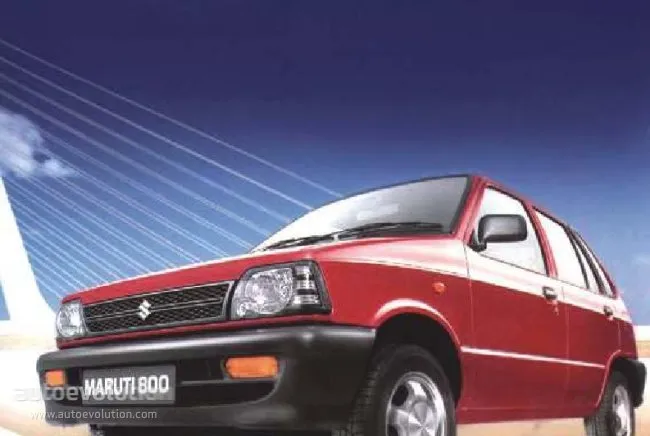
Maruti Suzuki 800 (2000 - present)

Maruti Suzuki · 1 trim

Maruti Suzuki 800

The Maruti Suzuki 800 (2000 - present) is available in 1 trims producing 50 to 50 hp. The fastest trim reaches 138 km/h. The lowest stated fuel consumption is 6.2 l/100 km.

Power
50 hp
0–100
22.3 s
Fuel economy
6.2 l/100 km
Cargo

800 Trims

Compare →
Trims and engine versions — Maruti Suzuki 800
Trim Fuel Power Torque 0–100 Top speed Fuel economy CO2 Select
0.8L 4MT (50 HP) Petrol 50 hp 58 Nm 22.3 s 138 km/h 6.2 l/100 km

Fuel economy and CO2 follow the stated test cycle. Manufacturer figures; deviations per market and option pack are possible.

Is Maruti Suzuki 800 a good choice against other models?

Average across every Maruti Suzuki 800 trim, compared with 4,683 trims of other cars from the 1997–2003 period.

Is Maruti Suzuki 800 a good choice against other models?
Measure This model Average Position
Power 50 hp 157 hp
better than 0%
Torque 58 Nm 245 Nm
better than 0%
Top speed 138 km/h 200 km/h
better than 1%
Acceleration 0–100 km/h 22.3 s 10.7 s
better than 0%
Combined consumption 6.2 l/100 km 8.4 l/100 km
better than 79%
Unladen weight 650 kg 1,394 kg
better than 100%

Percentages show the share of trims from the same period this model beats on that measure. Manufacturer figures.

Not stated by the manufacturer: co2 emissions and cargo volume. Those measures are left out of the comparison.

Comparable models from other brands

Mercedes-Benz Fiat Citroën Buick

About Maruti Suzuki 800

Due to specific laws, carmakers who wanted to sell vehicles in India had to produce them inside the country to avoid high import taxes.

In the early '80s, Suzuki found Maruti as a local partner for assembling vehicles. The first generation of the Maruti Suzuki 800 appeared in 1983, followed by a second generation in 1986. Maruti, on the other hand, noticed that with some effort could export the vehicle to other markets. So in 2000 it started the production of an enhanced version of the 800's second generation.

The car's design was the least concern of the Indian automaker, so the vehicle looked like a pile of bricks with rectangular headlights at the front and corner-mounted turn signals. In addition, Maruti added a set of signal repeaters on the front fenders. The flat surfaces were easy and cheap to build, and the metal sheets were produced in India and they were very thin, so the overall weight would be kept at a minimum. Despite the short length of the vehicle, it featured four doors and, on the sides, the 800 also sported a third window behind the rear doors. Finally, at the back, the car sported a flat, vertical tailgate.

Inside, Maruti installed thin, low-mounted seats for the front passengers and a folding bench for the rear ones. Technically, it was homologated for five occupants, but there was hardly room for four. As for the trunk, that was enough for a briefcase and a sandwich. The dashboard was squared, and the instrument cluster that fronted the driver sported just a few dials for the speedometer, fuel level, and water temperature.

Under the hood, Maruti used the license-built 800 cc engine provided by Suzuki. It was paired as standard to a five-speed manual.

How much power does the Maruti Suzuki 800 have?

The most powerful Maruti Suzuki 800 trim is the 0.8L 4MT (50 HP) with 50 hp. The model has 1 trims, starting at 50 hp.

What is the fuel consumption of the Maruti Suzuki 800?

The most economical Maruti Suzuki 800 trim is the 0.8L 4MT (50 HP), with a stated combined consumption of 6.2 l/100 km and — g CO2 per km.

How quickly does the Maruti Suzuki 800 accelerate from 0 to 100 km/h?

The quickest trim is the 0.8L 4MT (50 HP): 0-100 km/h in 22.3 seconds, with a top speed of 138 km/h.

Other Maruti Suzuki models