Skip to content
AD

Mercedes-Benz G1 (W103) (1926 - 1928)

Mercedes-Benz · 1 trim

Mercedes-Benz G1 (W103)

The Mercedes-Benz G1 (W103) (1926 - 1928) is available in 1 trims producing 50 to 50 hp. The fastest trim reaches 60 km/h. The lowest stated fuel consumption is 24.0 l/100 km.

Power
50 hp
0–100
Fuel economy
24.0 l/100 km
Cargo

G1 (W103) Trims

Compare →
Trims and engine versions — Mercedes-Benz G1 (W103)
Trim Fuel Power Torque 0–100 Top speed Fuel economy CO2 Select
3.1 Petrol 50 hp 151 Nm 60 km/h 24.0 l/100 km 571 g/km

Fuel economy and CO2 follow the stated test cycle. Manufacturer figures; deviations per market and option pack are possible.

Is Mercedes-Benz G1 (W103) a good choice against other models?

Average across every Mercedes-Benz G1 (W103) trim, compared with 52 trims of other cars from the 1923–1929 period.

Is Mercedes-Benz G1 (W103) a good choice against other models?
Measure This model Average Position
Power 50 hp 96 hp
better than 25%

Percentages show the share of trims from the same period this model beats on that measure. Manufacturer figures.

Not stated by the manufacturer: acceleration 0–100 km/h, cargo volume and unladen weight. Those measures are left out of the comparison.

Comparable models from other brands

Maruti Suzuki Fiat Citroën Buick Hindustan BMW

About Mercedes-Benz G1 (W103)

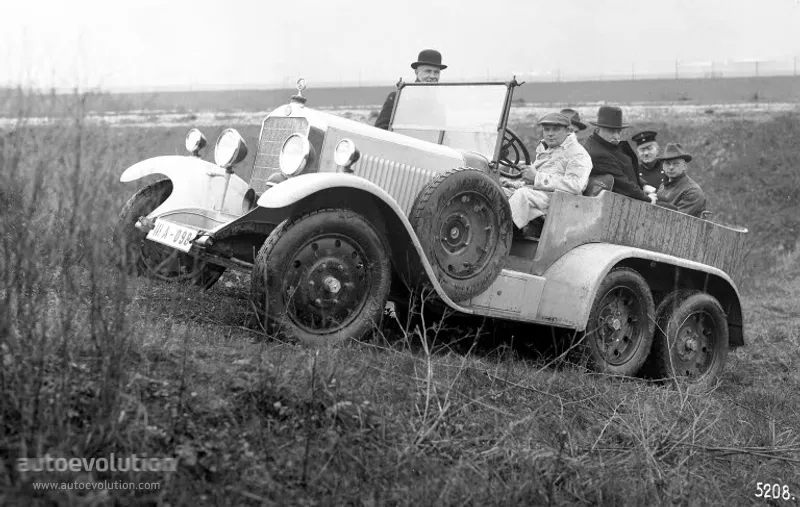
After WWI, Germany was denied to develop military vehicles, but some researches could still be made, and such was the situation with the Mercedes-Benz G1.

At the beginning of the '20s, there was a high demand for trucks of all sizes. Mercedes-Benz started researching for a new vehicle, able to cope with off-road and uneven terrain. It was the first step toward a vehicle that was suitable for the trucking companies and the army as well.

There were allegedly seven Mercedes-Benz G1 vehicle built by the German carmaker. It was more of a study to find out if that kind of vehicle would be suitable for off-road use. In the '20s, the Autobahn network didn't exist yet and most of Germany's roads were unpaved. The vehicle featured a high ground clearance, two axles in the rear equipped with twin wheels. It was a very good base for a truck.

The prototypes were designed to carry up to six passengers, although the twin rear-wheels might suggest the ability to carry heavier bodyworks (i.e. armored). It was used in some military exercises. Soon after, the concept vehicles were taken back and the carmaker started a new development, for a better vehicle, the G4. The G1 never went into production.

It featured a simple layout with an inline-six engine that offered just 50 hp. Its on-road performance was limited due to the tires performance.

How much power does the Mercedes-Benz G1 (W103) have?

The most powerful Mercedes-Benz G1 (W103) trim is the 3.1 with 50 hp. The model has 1 trims, starting at 50 hp.

What is the fuel consumption of the Mercedes-Benz G1 (W103)?

The most economical Mercedes-Benz G1 (W103) trim is the 3.1, with a stated combined consumption of 24.0 l/100 km and 571 g CO2 per km.

Other Mercedes-Benz models