
Skip to content
AD

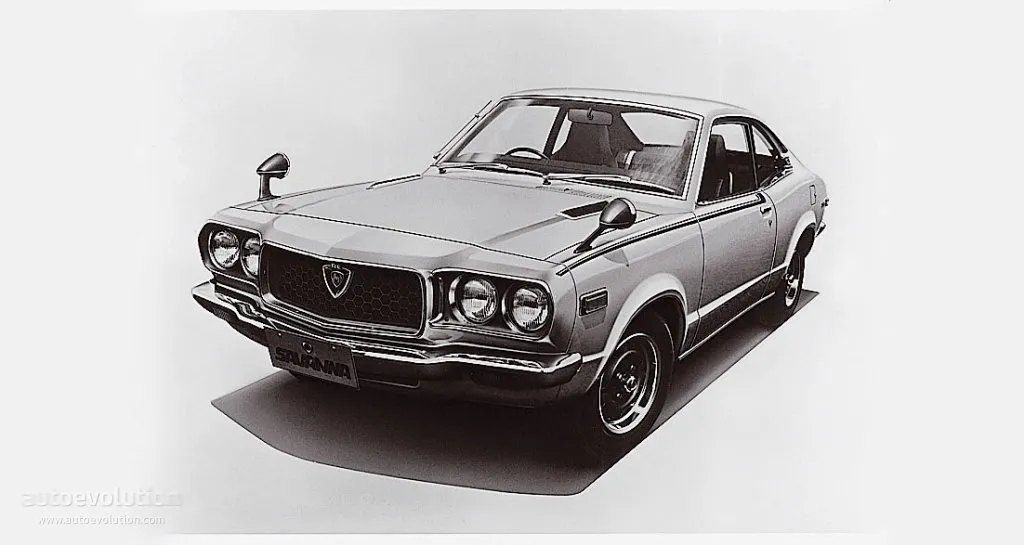
Mazda RX-3 (1971 - 1978)

Mazda · 1 trim

Mazda RX-3

The Mazda RX-3 (1971 - 1978) is available in 1 trims producing 110 to 110 hp. The fastest trim reaches 185 km/h.

Power
110 hp
0–100
10.8 s
Fuel economy
Cargo

RX-3 Trims

Compare →
Trims and engine versions — Mazda RX-3
Trim Fuel Power Torque 0–100 Top speed Fuel economy CO2 Select
2.0 Rotary Petrol 110 hp 135 Nm 10.8 s 185 km/h

Fuel economy and CO2 follow the stated test cycle. Manufacturer figures; deviations per market and option pack are possible.

Is Mazda RX-3 a good choice against other models?

Average across every Mazda RX-3 trim, compared with 461 trims of other cars from the 1968–1974 period.

Is Mazda RX-3 a good choice against other models?
Measure This model Average Position
Power 110 hp 159 hp
better than 37%
Torque 135 Nm 247 Nm
better than 25%
Top speed 185 km/h 181 km/h
better than 57%
Acceleration 0–100 km/h 10.8 s 12.5 s
better than 55%
Unladen weight 884 kg 1,268 kg
better than 89%

Percentages show the share of trims from the same period this model beats on that measure. Manufacturer figures.

Not stated by the manufacturer: combined consumption, co2 emissions and cargo volume. Those measures are left out of the comparison.

Comparable models from other brands

Peugeot Renault Mercedes-Benz Audi Opel Tata Motors

About Mazda RX-3

Mazda started introducing rotary engines since the Japanese regulations less taxed them, and the RX3 was an important step forward in that area.

Mazda offered the RX3 as a replacement for the previous RX2 model. It was available as a coupe, sedan, or station wagon. The Japanese carmaker tried to make the vehicle sporty enough to appeal to the younger generation but comfortable and well equipped for young families.

At the front, it featured dual round headlights and a separate grille between them as the original 1964 ½ Mustang. Even if it was way shorter than the famous pony-car, the RX3 featured a sloped rear window, making the car look even smaller. In the rear, the Japanese designers installed another pair of dual taillights, like some other European carmakers.

Inside, Mazda installed vinyl-covered seats with embossed "pleats" and emblems, but with good finishes. The instrumentation was complete with two main dials in the instrument cluster, and four additional gauges mounted high on the center stack. The Japanese designers placed the radio above the HVAC system, which was a much logical solution. Mazda installed a badge in the middle of the three-spoke steering wheel with the rounded triangular shape of a Wankel rotary engine piston.

The 1.2-liter Wankel engine was designed, so the owner paid smaller taxes, and it offered 90 hp. It was an unusually high specific output. Yet, the fuel-efficiency was worse than most of the similar cars on the market. Its live rear axle with leaf springs was unsuitable for a sporty coupe, but at least it featured power brakes with discs at the front and drums in the rear.

How much power does the Mazda RX-3 have?

The most powerful Mazda RX-3 trim is the 2.0 Rotary with 110 hp. The model has 1 trims, starting at 110 hp.

How quickly does the Mazda RX-3 accelerate from 0 to 100 km/h?

The quickest trim is the 2.0 Rotary: 0-100 km/h in 10.8 seconds, with a top speed of 185 km/h.

Other Mazda models

Mazda 121 (Mk.1)

1987 - 1991 · 2 trims

Power
67 hp
0–100
11.6 s
Fuel economy
6.7

Petrol

Mazda MX-3

1991 - 1998 · 4 trims

Power
136 hp
0–100
8.5 s
Fuel economy
7.4

Petrol

Mazda Xedos 6

1992 - 1999 · 5 trims

Power
160 hp
0–100
9.3 s
Fuel economy
7.5

Petrol

Mazda MX-6

1992 - 1997 · 2 trims

Power
165 hp
0–100
8.1 s
Fuel economy
8.0

Petrol