Skip to content
AD

Mitsubishi L300 (1986 - 1994)

Mitsubishi · 3 trims

Mitsubishi L300

The Mitsubishi L300 (1986 - 1994) is available in 3 trims producing 69 to 111 hp. The fastest trim reaches 154 km/h. The lowest stated fuel consumption is 8.7 l/100 km.

Power
111 hp
0–100
15.0 s
Fuel economy
8.7 l/100 km
Cargo

L300 Trims

Compare →
Trims and engine versions — Mitsubishi L300
Trim Fuel Power Torque 0–100 Top speed Fuel economy CO2 Select
2.5L 5MT FWD (69 HP) Diesel 69 hp 146 Nm 130 km/h 8.7 l/100 km 231 g/km
2.0L 5MT FWD (90 HP) Petrol 90 hp 148 Nm 21.1 s 140 km/h 11.8 l/100 km 281 g/km
2.4L 5MT FWD (111 HP) Petrol 111 hp 184 Nm 15.0 s 154 km/h 11.4 l/100 km 272 g/km

Fuel economy and CO2 follow the stated test cycle. Manufacturer figures; deviations per market and option pack are possible.

Is Mitsubishi L300 a good choice against other models?

Average across every Mitsubishi L300 trim, compared with 1,223 trims of other cars from the 1983–1989 period.

Is Mitsubishi L300 a good choice against other models?
Measure This model Average Position
Power 90 hp 121 hp
better than 33%
Torque 159 Nm 180 Nm
better than 49%
Top speed 141 km/h 184 km/h
better than 4%
Acceleration 0–100 km/h 18.1 s 12.1 s
better than 7%
Combined consumption 10.6 l/100 km 8.6 l/100 km
better than 16%
CO2 emissions 261 g/km 200 g/km
better than 10%

Percentages show the share of trims from the same period this model beats on that measure. Manufacturer figures.

Not stated by the manufacturer: cargo volume and unladen weight. Those measures are left out of the comparison.

Comparable models from other brands

Hyundai Suzuki Renault Proton Opel

About Mitsubishi L300

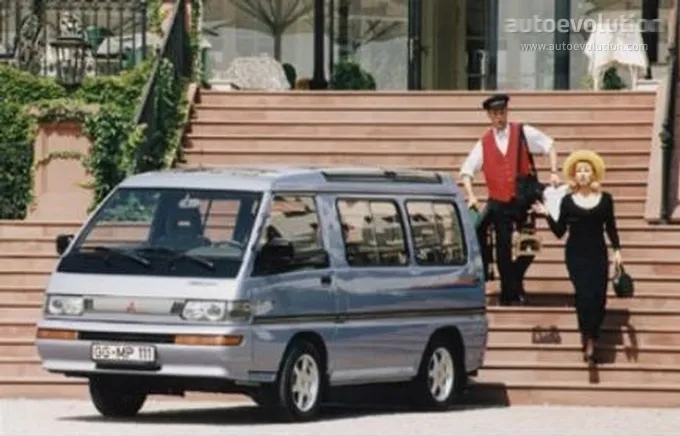
Mitsubishi introduced the third generation of the L300 minivan in 1986 and sold it under different names globally, while the U.S. received it in 1987.

When the Japanese carmaker designed the third generation of the Delica for the Japanese market, it built it as a light-utility van adapted as a passenger version. But soon, it became a vehicle chosen by hotels and companies as a shuttle bus.

Its roots as a utility vehicle were evident, despite its raked windshield at the front. The flat front panel sported a pair of squared headlights with separate corner-mounted turn signals. As a people-carrier, it featured a sliding door on the passenger side. Thus, Mitsubishi eased the ingress and egress to the car for the second and third rows. The L300's side windows and a glass roof option made it ideal for resorts and touristic trips.

Inside, the carmaker installed the front seats as forward as possible, on top of the front axle. Its dash panel was flat and low, with an angular-shaped instrument cluster in front of the driver. Between the front seats, the carmaker installed the engine covered by a big center console. There was room for six adults on the benches in the rear and an average-sized trunk behind them.

Under the hood, Mitsubishi installed a choice of two gasoline and one diesel engine, all paired to a five-speed manual. For the 2.4-liter version, the carmaker added an option for an automatic gearbox.

How much power does the Mitsubishi L300 have?

The most powerful Mitsubishi L300 trim is the 2.4L 5MT FWD (111 HP) with 111 hp. The model has 3 trims, starting at 69 hp.

What is the fuel consumption of the Mitsubishi L300?

The most economical Mitsubishi L300 trim is the 2.5L 5MT FWD (69 HP), with a stated combined consumption of 8.7 l/100 km and 231 g CO2 per km.

How quickly does the Mitsubishi L300 accelerate from 0 to 100 km/h?

The quickest trim is the 2.4L 5MT FWD (111 HP): 0-100 km/h in 15.0 seconds, with a top speed of 154 km/h.

Other Mitsubishi models

Mitsubishi Sigma

1991 - 1996 · 4 trims

Power
205 hp
0–100
8.1 s
Fuel economy
10.1

Petrol

Mitsubishi Grandis

2005 - present · 2 trims

Power
165 hp
0–100
10.0 s
Fuel economy
6.6

Petrol Diesel